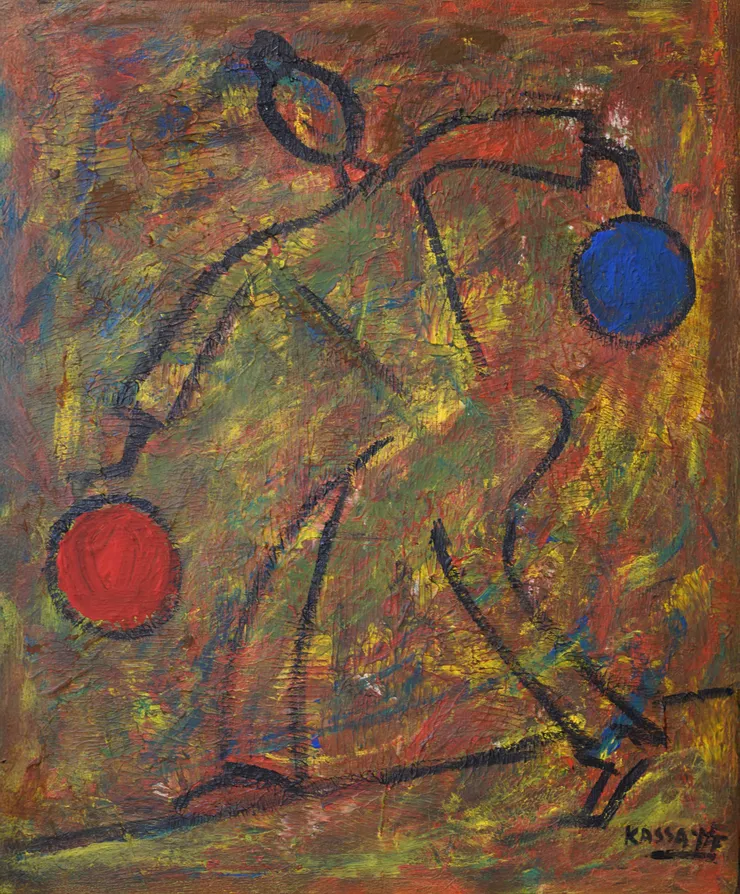
« Je suis un, mais je suis autre » — I am one, yet I am another. For thirty years, Kassa has painted this truth. In Joséphine Baker, he finds his philosophy made flesh — and finally, made eternal. Their meeting is not accidental. Baker lived the condition Kassa has spent a lifetime rendering visible.
Born Freda Josephine McDonald in St. Louis in 1906 — a Black girl in Jim Crow America who would become the most celebrated entertainer in Europe, a French Resistance officer, and a civil rights icon beside Martin Luther King Jr. Baker did not merely cross borders; she dissolved them. She was one self, yet another, and another.
Across Kassa's oeuvre, the fractured face is a map of displacement — identities split by borders, memory, expectation. The grid carries the weight of systems that try to define a life. Earth tones recall the homeland he left behind; chromatic bursts ignite the canvas with unrestrained presence. The impasto he scrapes, rebuilds, and excavates is an act of knowing — Kassa means "to scratch" in Bapounou — a lifelong search for the self that exists beneath imposed forms.
Kassa left Gabon as a young man and has not returned in over forty years. Baker left America at nineteen and renounced her citizenship. Both remade themselves far from home, carrying their first landscapes in the body. In his other work, the fractured face speaks to the impossibility of being seen whole. But in Baker, he finds something else: a woman who made fragmentation into spectacle, who turned the world's refusal to see her as one thing into permission to become everything. The fracture becomes not a wound but a window.
Where Kassa's portraits typically pause in fractured meditation, Baker electrifies his style. Fragmentation becomes choreography. The bold contour that fractures his other subjects here traces motion — the blur between poses, the echo of limbs in dance. The grid shifts from confinement to stage — floorboards, spotlights, the chessboard on which Baker outmaneuvered the world. The red lip — his emblem of the feminine principle, of presence refusing to disappear — flares here as theatrical command.
The arc of this collection mirrors her life:
Performance — bodies twisting like flames, the wild brilliance of the Danse Sauvage.
Stillness — the poised breath of a woman who understood that silence is power. Connection — figures dancing together, no longer alone in exile.
Panthéon — In 2021, Baker became the first Black woman interred in France's temple of heroes. Kassa paints her there not as marble, but as motion — still dancing between the columns.
Eternity — the self expanding beyond every system that tried to contain it. In Joséphine Baker, Kassa does not simply paint a legend. He paints a mirror.
One self. Yet another. Dancing still — forever.
This collection is being developed for exhibition at the Château des Milandes — Baker's beloved estate in the Dordogne, where she raised her "Rainbow Tribe" of twelve adopted children from twelve nations. It was from this château that she aided the French Resistance, smuggling messages in her sheet music and pinning notes in invisible ink inside her underwear. And it was to this château she returned after standing beside Martin Luther King Jr. at the March on Washington — the only woman to speak that day. There, as here, multiplicity was not a problem but proof: that family, like identity, can be built rather than inherited.
For pricing and availability, please inquire